
WTF does .box() do in Nitro Modules?
I was reading through the source of react-native-nitro-fetch and hit this inside nitroFetchOnWorklet:
return await runOnRuntimeAsync(rt, () => { 'worklet'; const unboxedNitroFetch = boxedNitroFetch.unbox(); const unboxedClient = unboxedNitroFetch.createClient(); const request = buildNitroRequestPure(input, init); const res = unboxedClient.requestSync(request); // ...});And up at the top of the module:
export const boxedNitroFetch = NitroModules.box(NitroFetch);I had no idea what box and unbox were. They sound like they should be obvious but nothing clicked. Here's what they actually are, from the source up.
Where setNativeState comes from
Before getting into box and unbox, it helps to know where setNativeState actually comes from, because it's the root of the whole problem.
setNativeState is part of JSI, the engine-agnostic C++ interface that sits between React Native and the JS engine. JSI is what lets React Native swap between Hermes and JSC without rewriting every native module. Hermes supported this API before JSC did, but the API you call from native code is a JSI API.
JSC didn't support it until late 2023. Before that, the JSC implementation literally threw std::logic_error("Not implemented") if you tried to call it. Third-party library authors were hitting 2-4x performance regressions because they had to fall back to the slower HostObject approach on JSC. React Native's own internals didn't roll it out internally until October 2023.
Nitro uses NativeState as the foundation for HybridObject. It didn't create the API. It built its object model around it.
What a HybridObject is made of
A Nitro HybridObject is a C++ object exposed to JavaScript through JSI. In JSI, it's represented as two things glued together:
- A prototype chain: the JS methods like
createClient,requestSync, etc. - A
jsi::NativeStatepointer: the actual C++ instance, attached directly to the JS object
You can see this in HybridObject.cpp:
jsi::Value HybridObject::toObject(jsi::Runtime& runtime) { // Get the object's base prototype (global & shared) jsi::Value prototype = getPrototype(runtime); // Create the object using Object.create(...) jsi::Object object = CommonGlobals::Object::create(runtime, prototype); // Assign NativeState to the object so the prototype can resolve the native methods object.setNativeState(runtime, shared()); return object;}setNativeState attaches a C++ pointer to a JS object. When JS calls a method on that object, JSI looks up the NativeState pointer and dispatches the call to the right C++ method. It's clean, fast, and type-safe.
But the JS object that holds that NativeState belongs to the specific jsi::Runtime that created it. The underlying C++ object can be reused, but the JS wrapper cannot just be picked up and dropped into another runtime.
The worklet runtime problem
createWorkletRuntime from react-native-worklets spins up a completely separate JS engine instance. Its own jsi::Runtime, its own heap, its own global object. When you call runOnRuntimeAsync(rt, () => { 'worklet'; ... }), that closure executes in a different engine than the one your React app runs in. They're isolated.
If you try to close over a HybridObject directly in a worklet closure, the worklets library has to serialize it and recreate something equivalent in the worklet runtime. Historically, that was the problem. A Nitro HybridObject is not a plain object. It has a custom prototype chain and a NativeState-backed JS wrapper. Worklet libraries knew how to move simpler values and HostObjects around, but not this exact shape.
So you can't just do this:
// This doesn't workconst myFetch = NitroFetchSingleton;runOnRuntimeAsync(rt, () => { 'worklet'; myFetch.createClient(); // myFetch's NativeState belongs to the main runtime});What box() actually does
NitroModules.box() converts a HybridObject from the newer jsi::NativeState representation into an older, simpler one: a jsi::HostObject.
HostObject is JSI's original escape hatch for native interop. You implement a get() method in C++, and JSI calls it whenever JavaScript accesses a property. HostObject does not use NativeState. It's a plain C++ virtual interface that the worklet serializer already knows how to move across runtimes.
Here's the entire BoxedHybridObject class from Nitro's source:
class BoxedHybridObject final : public jsi::HostObject {public: explicit BoxedHybridObject(const std::shared_ptr<HybridObject>& hybridObject) : _hybridObject(hybridObject) {}public: jsi::Value get(jsi::Runtime& runtime, const jsi::PropNameID& propName) override; std::vector<jsi::PropNameID> getPropertyNames(jsi::Runtime& runtime) override;private: std::shared_ptr<HybridObject> _hybridObject;};That's it. A thin wrapper holding a std::shared_ptr to the real C++ object. The shared_ptr is plain heap memory. It has nothing to do with any JS runtime. It's a reference-counted pointer that lives in C++ land, not in JSI land.
And unbox is the only property exposed:
jsi::Value BoxedHybridObject::get(jsi::Runtime& runtime, const jsi::PropNameID& propName) { if (jsi::PropNameID::compare(runtime, propName, PropNameIDCache::get(runtime, "unbox"))) { return jsi::Function::createFromHostFunction( runtime, PropNameIDCache::get(runtime, "unbox"), 0, [hybridObject = _hybridObject](jsi::Runtime& runtime, ...) -> jsi::Value { return hybridObject->toObject(runtime); }); } return jsi::Value::undefined();}When .unbox() is called, it calls hybridObject->toObject(runtime), passing in the new runtime. That's the same toObject from earlier, which calls setNativeState on the current runtime. The result is a fully wired HybridObject rooted in the worklet runtime, backed by the same C++ instance.
box and unbox were added to Nitro in a single commit in September 2024, titled explicitly: "Add NitroModules.box(...) to support using Nitro Modules from any Runtime/Worklets context." Worklets were the entire reason it was built.
The full flow
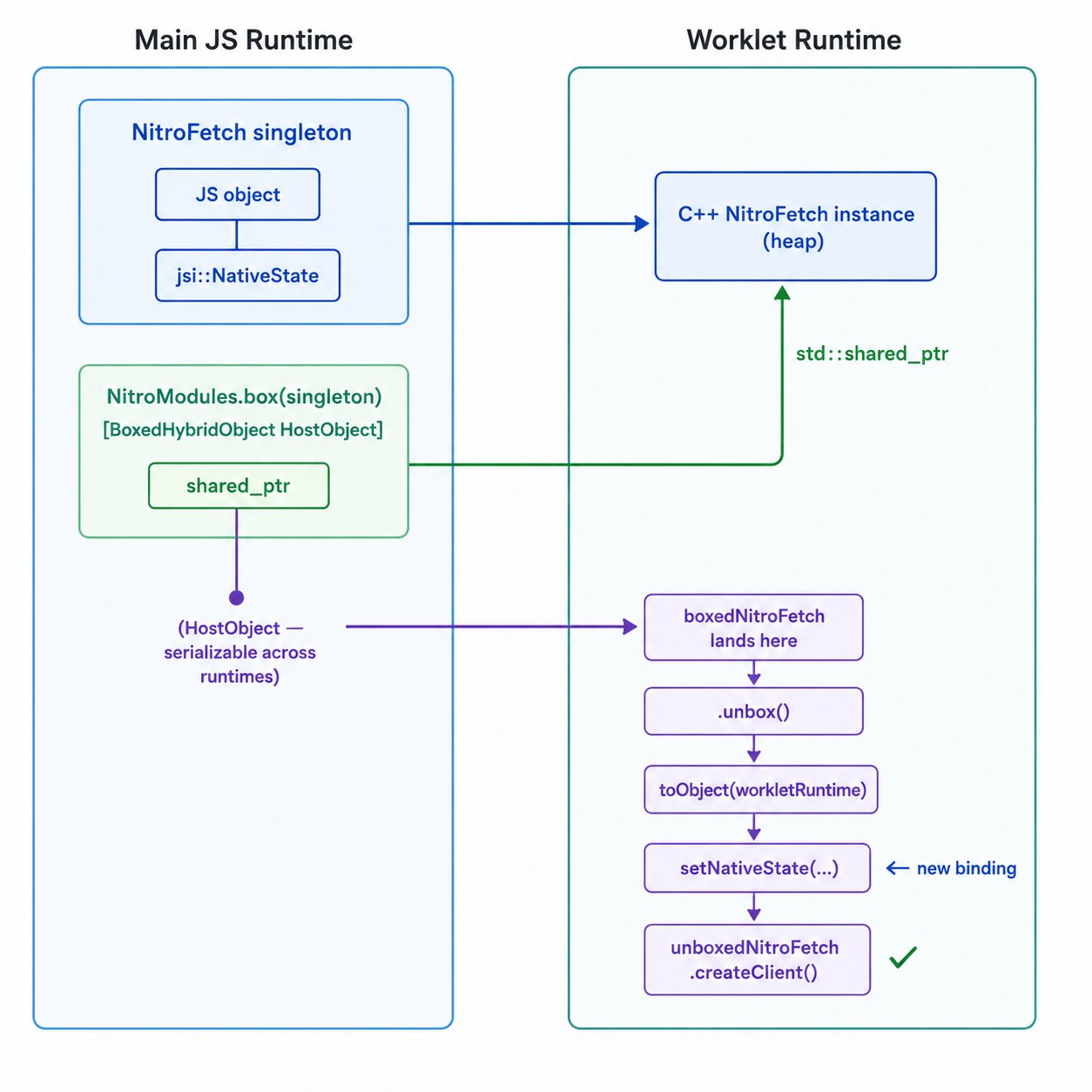
The C++ object is never copied. The shared_ptr just gets a new JS wrapper pointing at it, created fresh in the worklet runtime.
Why this also needs buildNitroRequestPure
There's a second wrinkle: worklets have a restricted JS environment. instanceof doesn't work across runtimes. The Headers class from the main runtime doesn't exist in the worklet. No Blob, no FormData, no async APIs.
So buildNitroRequestPure (note the Pure suffix) is a worklet-safe version of the normal request builder. It avoids instanceof in favor of Object.prototype.toString.call(), uses Object.keys() instead of Object.entries(), and throws explicitly if you pass a body type it can't handle synchronously:
function buildNitroRequestPure(input, init) { 'worklet'; // uses Object.prototype.toString.call() not instanceof // uses Object.keys() not Object.entries() // throws on FormData/Blob, no async resolution in worklets}The 'worklet' directive tells the worklet compiler to bundle this function into the worklet runtime's code. Functions without it can't be called from a worklet closure.
Is this still necessary?
This is where it gets interesting, because nitro-fetch is not an old codebase. The manual box/unbox call was introduced in March 2026, not during the first Nitro worklets experiments in 2024.
Yet the manual box/unbox is still there. The reason is subtle.
When that code first landed, nitro-fetch depended on react-native-worklets-core. Nitro's automatic worklets support targets react-native-worklets, where it registers custom serialization with registerCustomSerializable. That does not help react-native-worklets-core.
The code later migrated to react-native-worklets, but the explicit box stayed. That makes sense. box/unbox is the public documented path that works with any worklet runtime that can carry a HostObject. It also avoids relying on whether custom serialization is installed, which worklets package is being used, or which exact runtime path is executing.
nitroFetchOnWorklet also does not run on the standard UI worklet context. It spins up its own named background runtime:
nitroRuntime = createWorkletRuntime('nitro-fetch')Modern react-native-worklets does have custom serialization support, and it does load registered custom serializers into worklet runtimes. Nitro hooks into that by registering a nitro.HybridObject serializer that boxes during pack and unboxes during unpack.
But manual boxing is still the least surprising thing here. The code boxes one singleton once, captures the boxed HostObject, and unboxes it inside the runtime that needs to use it. No serializer magic required.
So the answer is: the automation exists, but this code still has a good reason to stay explicit.
For the standard case, closing over a HybridObject in a regular react-native-worklets worklet, Nitro's custom serializer should be able to handle it. But nitro-fetch is a library, not an app screen. It has to be more conservative, and the explicit box/unbox path is exactly what Nitro documents for cross-runtime usage.
Nitro's original docs for that September 2024 commit said:
"In future versions of react-native-worklets-core or react-native-reanimated we expect fully automatic jsi::NativeState support, which will make boxing obsolete."
That future is arriving in pieces. The mechanism is the same HostObject wrapper and shared_ptr trick either way. Sometimes you call it yourself. Sometimes the serializer calls it for you.
The timeline
- Hermes first, JSI API:
NativeStatebecomes the JSI way to attach C++ state to JS objects - JSC late 2023: JSC finally implements
setNativeState(it was throwing "Not implemented" before this) - October 2023: React Native rolls out
NativeStatein its own internals - September 2024: Nitro adds
box/unboxas a manual worklet workaround - Later worklets releases:
registerCustomSerializablegives worklets a hook for custom types - Nitro later: Nitro uses that hook for
react-native-workletsby registeringnitro.HybridObject - nitro-fetch March 2026: nitro-fetch still uses explicit
box/unbox, which keeps the code compatible with the documented cross-runtime path
The HostObject is the passport. The shared_ptr is the actual traveler.